Drafting a Corporate Policy for AI-Generated Content (2026 Template)
Learn how to draft a comprehensive corporate policy for AI-generated content in 2026. Includes a ready-to-use template covering IP ownership, disclosure requirements, approved tools, and EU AI Act compliance.
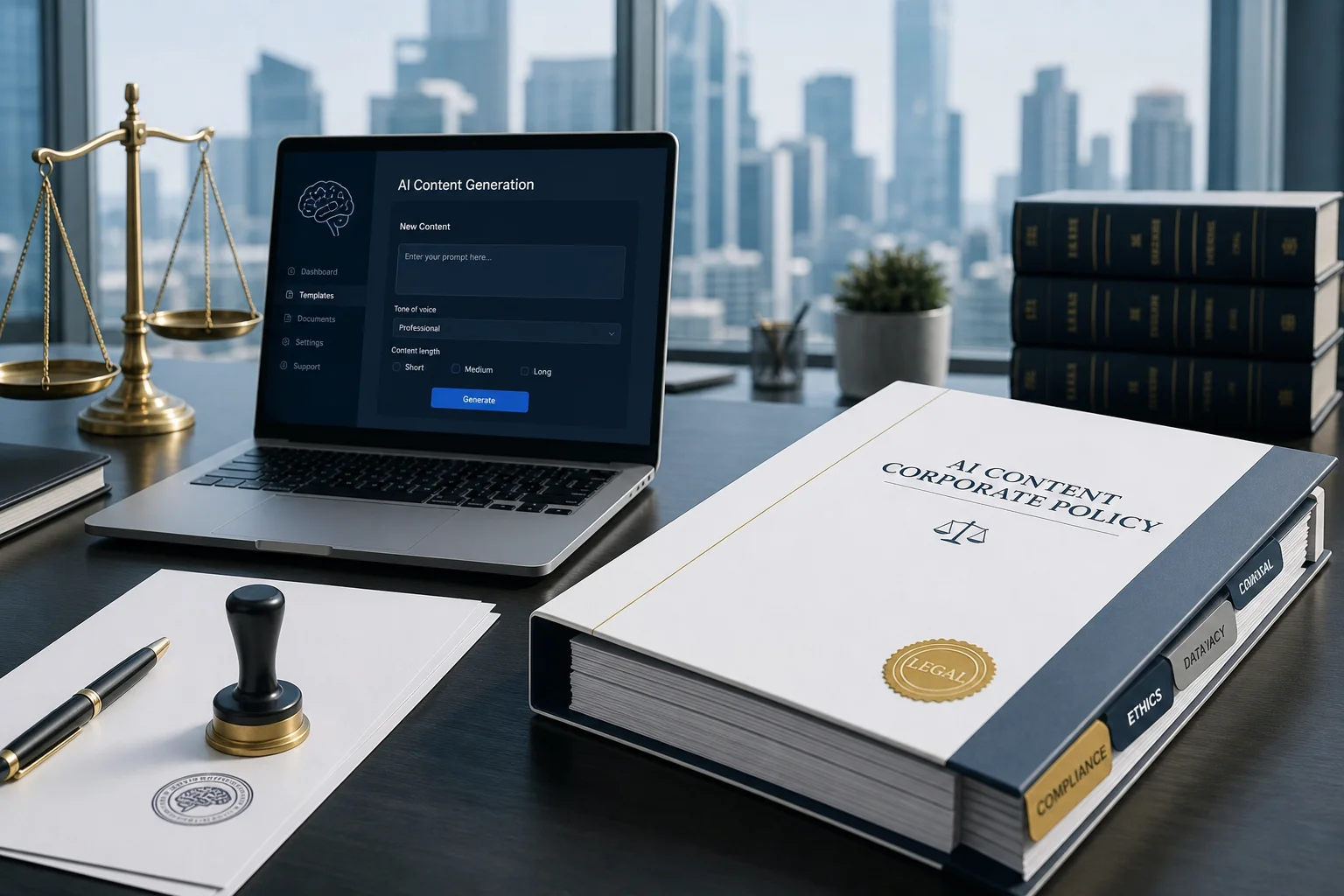
Every organization using generative AI tools faces a critical question: who owns the output, and what are the legal risks? Without a clear corporate policy on AI-generated content, businesses expose themselves to copyright infringement claims, intellectual property disputes, and regulatory penalties.
This guide walks you through drafting a comprehensive AI content policy for your organization in 2026 — complete with a ready-to-use template you can adapt to your needs.
Why Your Business Needs a Corporate AI Content Policy
The legal landscape around AI-generated content has shifted dramatically. The EU AI Act's transparency requirements are now enforceable, the US Copyright Office has clarified its stance on AI-assisted works, and courts worldwide are issuing rulings that directly impact how businesses use AI tools.
Here's what's at stake without a policy:
- Copyright ownership gaps — AI-generated content may not qualify for copyright protection, leaving your business assets unprotected
- Infringement liability — If AI tools reproduce copyrighted training data in their outputs, your company could face lawsuits
- Regulatory non-compliance — The EU AI Act requires disclosure of AI-generated content in certain contexts, with fines up to €35 million
- Employee confusion — Without clear guidelines, staff may use AI tools in ways that create legal exposure
- Client and vendor disputes — Contracts may not address AI-generated deliverables, creating ambiguity about rights
Companies like Samsung, Apple, and JPMorgan Chase implemented AI usage restrictions early. In 2026, the question isn't whether you need a policy — it's how comprehensive it should be.
Key Components of an AI-Generated Content Policy
A robust corporate policy on AI-generated content should address seven core areas. Let's break each one down.
1. Scope and Definitions
Your policy must clearly define what counts as "AI-generated content" versus "AI-assisted content." This distinction matters legally.
AI-generated content refers to outputs where the AI system produces the substantive creative expression with minimal human direction (e.g., asking ChatGPT to "write a blog post about X").
AI-assisted content refers to outputs where a human provides significant creative direction, selection, and arrangement, using AI as a tool (e.g., using AI to research, then writing and structuring the content yourself).
The US Copyright Office has consistently held that only works with sufficient human authorship qualify for copyright registration. Your policy should reflect this distinction.
Template language:
This policy applies to all content created using generative AI tools, including but not limited to: text generators (ChatGPT, Claude, Gemini), image generators (Midjourney, DALL-E, Stable Diffusion), code generators (GitHub Copilot, Cursor), video generators (Sora, Runway), and audio generators (ElevenLabs, Suno). It covers both fully AI-generated and AI-assisted outputs produced in the course of employment.
2. Approved Tools and Platforms
Not all AI tools carry the same legal risk. Your policy should maintain an approved list based on:
- Terms of service — Does the tool grant your company ownership of outputs? (OpenAI's enterprise terms differ from consumer terms)
- Training data provenance — Has the tool been trained on licensed data or potentially infringing datasets?
- Data privacy — Does the tool retain your inputs for training? (Critical for confidential business information)
- Indemnification — Does the provider offer IP indemnification? (Adobe Firefly, Getty Images' AI, and some enterprise tiers do)
| Risk Level | Examples | Policy Recommendation |
|-----------|----------|----------------------|
| Lower Risk | Enterprise AI tools with IP indemnity (Adobe Firefly Enterprise, Getty AI) | Approved for commercial use |
| Medium Risk | Enterprise tiers of major LLMs (ChatGPT Enterprise, Claude for Business) | Approved with human review |
| Higher Risk | Consumer-tier AI tools, open-source models with unclear training data | Restricted to internal drafts only |
| Prohibited | Tools trained on clearly pirated content, deepfake generators | Not permitted |
3. Intellectual Property Ownership and Rights
This is the most legally complex section. Your policy must address:
Who owns AI-assisted outputs? Under most employment agreements, work product belongs to the employer. But if the AI-generated portion isn't copyrightable, you may have less protection than you think.
Practical approach:
- Require sufficient human authorship in all client-facing and published content
- Document the human creative contributions (selection, arrangement, editing, original additions)
- Register important works with the Copyright Office, disclosing AI assistance as required
- Include AI-generated content clauses in client contracts and vendor agreements
Template language:
All AI-assisted content produced during employment is considered work product of [Company Name]. Employees must ensure that all published or client-facing content contains substantial human authorship, including original creative expression, editorial judgment, and substantive modifications beyond the AI's raw output. The company claims no copyright in purely AI-generated outputs that lack human authorship.
4. Disclosure and Transparency Requirements
The EU AI Act now requires that AI-generated content be labeled in specific contexts. Even where not legally mandated, transparency builds trust.
When disclosure is required:
- Content published in EU markets (per AI Act Article 50)
- Marketing materials that could mislead consumers about human involvement
- Academic or research publications
- Legal filings and regulatory submissions
- Client deliverables (unless contractually agreed otherwise)
When disclosure may be optional:
- Internal documents and drafts
- AI-assisted research and brainstorming
- Code where AI was used as an autocomplete tool
- Content substantially rewritten by humans
Template language:
AI-generated or AI-assisted content must be disclosed in the following circumstances: [list contexts]. Disclosure should use the format: "This content was created with AI assistance and reviewed by [human name/team]." Department heads may grant exceptions for content where AI assistance was minimal (e.g., grammar checking, formatting).
5. Quality Control and Human Review
AI outputs can contain hallucinations, biased content, or reproduced copyrighted material. Your policy needs a review framework.
Minimum review requirements:
- Factual verification — All claims, statistics, and citations must be verified by a human
- Originality check — Run outputs through plagiarism detection to catch reproduced training data
- Legal review — Content making legal, medical, or financial claims requires expert review
- Brand alignment — Ensure tone, messaging, and values match company standards
- Bias audit — Check for discriminatory language or stereotypes
Assign review levels based on content risk:
- High risk (legal documents, public statements, regulated content) → Senior review + legal sign-off
- Medium risk (marketing copy, blog posts, client communications) → Manager review
- Low risk (internal notes, brainstorming, code comments) → Self-review
6. Data Security and Confidentiality
What you put INTO an AI tool matters as much as what comes out.
Hard rules:
- Never input trade secrets, proprietary code, or confidential client data into consumer AI tools
- Never input personal data (employee or customer) without privacy impact assessment
- Use enterprise tiers with data processing agreements (DPAs) where available
- Maintain logs of what data was shared with which AI tools
Template language:
Employees must not input the following into any AI tool: (a) trade secrets or proprietary business information, (b) personal data of employees, customers, or partners, (c) confidential client information, (d) unpublished financial data, (e) security credentials or access tokens. Violations may result in disciplinary action up to termination.
7. Training, Compliance, and Enforcement
A policy is only as good as its implementation.
Required elements:
- Annual training for all employees who use AI tools
- Quarterly updates as laws and tools evolve
- Clear reporting mechanism for policy violations
- Designated AI compliance officer or team
- Regular audits of AI tool usage across departments
- Consequences for non-compliance (progressive discipline)
Ready-to-Use Corporate AI Content Policy Template
Below is a condensed template you can adapt. Customize the bracketed sections for your organization.
[COMPANY NAME] — Generative AI Content Policy
Effective Date: [Date]
Last Updated: [Date]
Policy Owner: [Legal/Compliance Team]
1. Purpose
This policy governs the use of generative AI tools for creating content in the course of employment at [Company Name]. It ensures legal compliance, protects intellectual property, and maintains quality standards.
2. Scope
Applies to all employees, contractors, and third-party vendors creating content on behalf of [Company Name] using any generative AI tool.
3. Approved Tools
[Maintain list — review quarterly]
4. Permitted Uses
- Drafting and brainstorming (with human review)
- Research assistance and summarization
- Code generation (with testing and review)
- Translation and localization assistance
- Data analysis and visualization
5. Prohibited Uses
- Generating final deliverables without human review
- Inputting confidential or personal data
- Creating content that impersonates real individuals
- Using AI to circumvent licensing or copyright restrictions
- Generating content for regulated communications without legal review
6. Intellectual Property
All AI-assisted work product belongs to [Company Name]. Employees must ensure sufficient human authorship for copyright eligibility. Document AI contributions for IP registration purposes.
7. Disclosure
AI assistance must be disclosed per [Company Name]'s transparency guidelines and applicable law, including EU AI Act requirements.
8. Review and Approval
[Define approval workflow by content risk level]
9. Compliance
Violations subject to [Company Name]'s standard disciplinary procedures. Report concerns to [AI Compliance Officer/email].
Implementation Roadmap: Rolling Out Your Policy
Drafting the policy is step one. Here's how to implement it effectively:
Month 1: Assessment
- Audit current AI tool usage across departments
- Identify high-risk use cases
- Review existing contracts for AI-related gaps
Month 2: Drafting and Review
- Draft policy with input from Legal, IT, HR, and department heads
- External legal review (especially for EU AI Act compliance)
- Board or executive approval
Month 3: Rollout
- All-hands announcement and training sessions
- Update employee handbook and onboarding materials
- Configure approved tools with enterprise settings
- Establish monitoring and reporting mechanisms
Ongoing:
- Quarterly policy reviews as laws evolve
- Annual training refreshers
- Track regulatory developments (US Copyright Office guidance, EU enforcement actions, new court rulings)
How This Connects to Broader AI Copyright Compliance
Your corporate AI content policy doesn't exist in isolation. It should align with your broader AI copyright compliance strategy, including:
- Vendor contracts — Ensure AI tool providers offer appropriate IP warranties
- Client agreements — Clarify AI usage in deliverables and who bears infringement risk
- Insurance — Review whether your E&O or cyber insurance covers AI-related IP claims
- International operations — Different jurisdictions have different rules; the EU AI Act is just the beginning
For businesses navigating active litigation risks, our AI copyright lawsuit tracker provides context on how courts are ruling on these issues.
Key Takeaways
1. Every business using AI tools needs a written policy — verbal guidelines aren't sufficient for legal compliance or employee clarity
2. Distinguish AI-generated from AI-assisted content — the copyright implications are fundamentally different
3. Maintain an approved tools list — not all AI platforms carry equal legal risk
4. Require human authorship — this is your best path to copyright protection for AI-assisted works
5. Plan for the EU AI Act — transparency requirements are now enforceable with significant penalties
6. Update regularly — AI law is evolving rapidly; a static policy becomes outdated within months
7. Train your people — the best policy fails without employee understanding and buy-in
Disclaimer: This article provides general information about AI copyright law and corporate policy considerations. It is not legal advice. Consult a qualified attorney for guidance specific to your organization's circumstances and jurisdiction.
Related Articles
AI Copyright Incident Response Plan: What to Do in the First 72 Hours After an Infringement Claim
A practical 72-hour incident response plan for AI copyright claims, covering evidence preservation, ...
GuideAI Procurement Copyright Compliance Checklist: 24 Questions to Ask Before Buying Generative AI in 2026
A practical 2026 checklist for legal, procurement, and product teams reviewing generative AI vendors...
GuideAI Output Copyright Clearance Workflow: A Practical 2026 Guide for Marketing Teams
A practical seven-step workflow for clearing AI-assisted marketing assets before publication, with p...
GuideAI Training Data Audit Trail: A Copyright Compliance Guide for Product Teams in 2026
A practical guide to building an AI training data audit trail that can survive licensing reviews, ta...
GuideAI Copyright Due Diligence Checklist: What to Audit Before You Launch an AI Product in 2026
A practical 2026 due-diligence checklist for AI product teams: training data, licenses, fair use ris...