Hobbs & Stone v. Meta: Authors File Class Action Naming Zuckerberg Personally
A new class action filed May 22, 2026, names Mark Zuckerberg personally for what may be the largest literary piracy in history — torrenting millions of books from shadow libraries to train Meta's Llama AI.
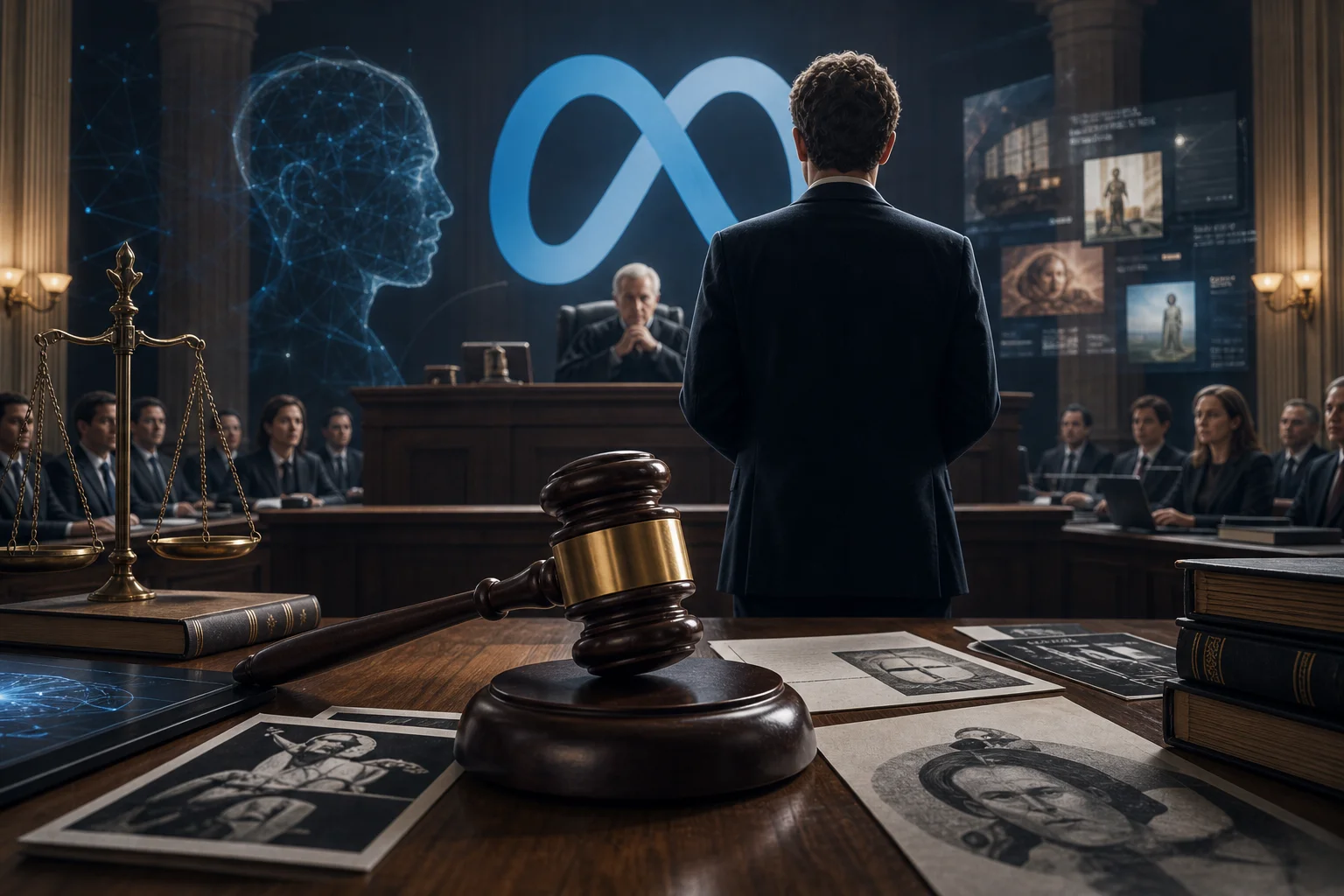
Hobbs & Stone v. Meta: Authors File Class Action Naming Zuckerberg Personally for "Largest Literary Piracy in History"
A new class action filed May 22, 2026, in the Southern District of New York alleges that Meta Platforms engaged in what may be "the largest infringement — literary piracy — in history" to train its Llama AI models. The complaint, brought by authors Jeff Hobbs and Professor A. Douglas Stone, names Meta CEO Mark Zuckerberg personally alongside AI research executives Joelle Pineau and Guillaume Lample as individual defendants.
The 32-page complaint, filed in the U.S. District Court for the Southern District of New York, represents a significant escalation in the ongoing legal battles between authors and AI companies. Unlike previous cases that primarily challenged whether AI training on copyrighted works constitutes fair use, this lawsuit draws a bright line around the method of acquisition — alleging that Meta intentionally torrented millions of copyrighted books from notorious pirate repositories rather than licensing them.
A Fundamentally Different Legal Theory
The complaint opens with a striking distinction that sets it apart from previous AI copyright cases:
"This case is fundamentally different from cases in which courts have considered whether the use of lawfully acquired copyrighted materials for technological purposes could qualify as fair use."
The authors' legal team, led by attorney David S. Stone, argues that Meta didn't just use copyrighted works — it stole them through BitTorrent downloads from shadow libraries including Library Genesis (LibGen), Anna's Archive, and Z-Library. The complaint asserts that "a defendant may not unlawfully pirate millions of copyrighted works and then retroactively immunize that piracy by claiming the stolen works were later used for AI training."
This theory sidesteps the fair use question entirely. If the works were acquired through piracy, the argument goes, any downstream use — transformative or not — is tainted by the illegal acquisition.
Naming Names: Zuckerberg, Pineau, and Lample
One of the most aggressive moves in the complaint is naming specific Meta executives as individual defendants:
- Mark Zuckerberg — The complaint alleges he "personally authorized and actively encouraged the mass download and infringement." When Meta engineers struggled to source sufficient training material, Zuckerberg allegedly "demanded a solution," which ultimately led to the torrenting. The complaint cites a New York-based Meta AI employee who confirmed the decision to torrent was made only "after a prior escalation to MZ."
- Joelle Pineau — Meta's Vice President of AI Research and head of FAIR (Fundamental AI Research). The complaint states she "oversaw the development of Meta's Llama Models" and bears "direct responsibility for the devastation wrought upon the literary ecosystem."
- Guillaume Lample — A former Meta research scientist who is now co-founder of AI competitor Mistral AI. The complaint alleges Lample "likely torrented Meta's first copy of the shadow library LibGen — a copy that has since 'vanished from Meta's possession.'"
By naming individuals, the plaintiffs are attempting to pierce the corporate veil and establish personal liability — a strategy that could have far-reaching implications for how AI companies structure their training data operations.
The Piracy Infrastructure
The complaint goes into granular detail about Meta's alleged piracy operations. According to the filing, Meta deployed scripts specifically designed to delete copyright management information (CMI) — stripping away copyright notices, author names, ISBN numbers, and publication information to "conceal its training sources and to facilitate and conceal their unauthorized use."
This detail echoes a ruling from earlier in May 2026, where a federal judge found that NVIDIA's shadow library scripts "have no other purpose" than copyright infringement — a decision the Hobbs complaint references to strengthen its argument.
Meta also allegedly kept BitTorrent seeding enabled during downloads, meaning it simultaneously redistributed the pirated works to thousands of other users. The complaint notes Meta "could have prevented this distribution and copying from happening by simply changing a setting on BitTorrent but intentionally chose not to because allowing the pirated works to be copied and distributed to others was faster."
The Plaintiffs and the Proposed Class
Lead plaintiff Jeff Hobbs is the author of The Tourists and The Short and Tragic Life of Robert Peace. Co-plaintiff A. Douglas Stone is a professor of physics at Yale University and author of Einstein and the Quantum: The Quest of the Valiant Swabian. Stone also brings claims as the inheritor of copyrights belonging to his father, the late Professor Alan A. Stone of Harvard Law School.
Both plaintiffs state they were "willing to license [their] works for AI training but [were] never approached by any Defendant or offered any compensation."
The complaint seeks to certify a class of "tens of millions" of authors whose works were pirated through shadow libraries and used to train Llama.
Market Harm Evidence
The complaint includes notable internal Meta communications that the plaintiffs argue demonstrate market harm:
- Meta software engineer David Esiobu internally acknowledged that "Llama [wa]s annoyingly good at quoting books"
- Meta researcher Melanie Kambadur confirmed that downstream applications of Llama include use "as an aid for writing fiction or to output whole poems"
The complaint argues this creates "indirect substitution" — where Llama generates content that competes with the original works, diluting the market for those works. The plaintiffs claim Meta "predicted that by 2035, it will reap $460 billion to $1.4 trillion of revenue from its AI products, including Llama."
How This Differs From Other AI Copyright Cases
This is now at least the third major class action against Meta over Llama training data, but it differs in several key respects:
| Case | Filed | Key Distinction |
|------|-------|-----------------|
| Kadrey v. Meta (2023) | 2023 | Focus on fair use; no personal liability for executives |
| Hachette/Macmillan/Turow v. Meta (May 2026) | May 18, 2026 | Publisher-led; Zuckerberg named after amended complaint |
| Hobbs & Stone v. Meta (May 2026) | May 22, 2026 | Author class action; piracy-as-acquisition theory; individual executives named from day one |
The Hobbs complaint arrives just days after publishers Hachette, Macmillan, and Elsevier amended their own Meta lawsuit to name Zuckerberg personally on May 19, 2026 — suggesting a coordinated legal strategy to hold tech executives accountable.
The CMI Stripping Angle
The removal of Copyright Management Information (CMI) is a significant element of the complaint. Under 17 U.S.C. § 1202, it is unlawful to intentionally remove or alter CMI knowing it will facilitate infringement. The complaint alleges Meta developed "scripts specifically designed to delete copyright notices, author names, ISBN numbers, and publication information" from the pirated works.
This isn't just a copyright infringement claim — it's a separate statutory violation that carries its own damages and doesn't require proving the underlying use was infringing. Each CMI violation can carry statutory damages of $2,500 to $25,000. With "tens of millions" of works allegedly involved, the potential exposure is staggering.
What Happens Next
The case is docketed as 1:26-cv-04314 (Hobbs v. Platforms, Inc.) in the Southern District of New York. Meta has not yet filed a response. Given the complexity and the class action nature, the case could take months before any substantive rulings.
The selection of the Southern District of New York as venue is strategic. The complaint notes that "more than 7,000 authors reside in New York" and that NYC "is regarded as the epicenter of the U.S. literary industry." Meta maintains multiple offices in the district, including at 50 Hudson Yards.
Meta has publicly stated in other proceedings that its AI training constitutes fair use. However, the piracy-as-acquisition theory may prove harder to dismiss — courts have historically shown little tolerance for circumventing lawful markets to obtain copyrighted works, regardless of the end use.
The Bigger Picture
The Hobbs complaint is part of an accelerating trend. As of late May 2026, we're seeing:
1. Multiple class actions against every major AI developer (OpenAI, Meta, Anthropic, NVIDIA)
2. Individual executive liability becoming a standard demand (Zuckerberg named in two Meta lawsuits in the same week)
3. New legal theories that don't depend on resolving the fair use question (piracy-based acquisition, CMI stripping)
4. International momentum — the EU AI Act's transparency requirements and the German OLG Düsseldorf ruling on AI image copyright are creating parallel pressure
The case also comes amid broader scrutiny of Meta's AI ambitions. With Meta projecting up to $1.4 trillion in AI revenue by 2035, the stakes couldn't be higher for both sides.
Key Takeaways
- A new class action filed May 22, 2026, alleges Meta torrented millions of copyrighted books from pirate sites to train Llama
- Mark Zuckerberg is named personally, alongside AI executives Joelle Pineau and Guillaume Lample
- The legal theory bypasses fair use by arguing the works were pirated, not lawfully acquired
- Meta allegedly stripped CMI from all works — a separate statutory violation under 17 U.S.C. § 1202
- This is the third major Meta AI training lawsuit and follows publisher amendments naming Zuckerberg personally just days earlier
- The case is in the Southern District of New York, the heart of the U.S. publishing industry
Disclaimer: This article is for informational purposes only and does not constitute legal advice. If you are an author concerned about your works being used for AI training, consult with a qualified copyright attorney.
Primary source: Complaint, Hobbs v. Platforms, Inc., No. 1:26-cv-04314 (S.D.N.Y. filed May 22, 2026), available on CourtListener.
Related Articles
AI Copyright Insurance in 2026: What Media, Software, and Marketing Teams Should Demand Before Relying on a Policy
A practical 2026 guide to AI copyright insurance: what policies actually cover, where exclusions hid...
GuideAI Copyright Incident Response Plan: What to Do in the First 72 Hours After an Infringement Claim
A practical 72-hour incident response plan for AI copyright claims, covering evidence preservation, ...
GuideAI Procurement Copyright Compliance Checklist: 24 Questions to Ask Before Buying Generative AI in 2026
A practical 2026 checklist for legal, procurement, and product teams reviewing generative AI vendors...
GuideAI Output Copyright Clearance Workflow: A Practical 2026 Guide for Marketing Teams
A practical seven-step workflow for clearing AI-assisted marketing assets before publication, with p...
GuideAI Training Data Audit Trail: A Copyright Compliance Guide for Product Teams in 2026
A practical guide to building an AI training data audit trail that can survive licensing reviews, ta...